

This guide examines 2026 Split vs Genuine Leather Handbags for buyers comparing performance, appearance, cost, and manufacturability. The practical choice depends on expected load, wear, care, finish, compliance needs, price position, and how the material interacts with seams, edges, hardware, and lining. Record the grade, thickness, color, surface finish, backing, and test requirements in the BOM or product specification. Confirm supplier descriptions with current documents, approved swatches, and physical testing before bulk production.
I used to be confused by "genuine leather1" labels when shopping for handbags. I once bought a bag marked "genuine leather1" that peeled off after just six months. Later, I found out it was low-grade bonded leather2. This experience made me realize the importance of understanding the difference between split leather3 and genuine leather1. Now, I want to share what I’ve learned to help you avoid the same mistakes.
In 2026, split leather3 is a mid-tier subset of genuine leather1. You should choose split leather3 if you want budget-friendly real leather. You should choose top-grain genuine leather1 if you value durability and long-term use. This guide will clarify how to select the right one for both shoppers and brands.

Understanding the core differences between split and genuine leather1 is the first step to smart choices. So, I will break down definitions, selection tips, and production strategies in the following parts. All these details come from my own research and conversations with leather industry professionals, and they will help you build a clear understanding step by step.
1. What Exactly Are Split Leather & "Genuine Leather" in 2026?
For related buyer guidance, review Genuine Leather Handbag Manufacturing alongside the specifications, evidence, and decision criteria in this section.
Vague "genuine leather1" claims used to mislead me a lot. I once thought all genuine leather1 was high-quality until I talked to a leather craftsman. He told me split leather3 is actually part of genuine leather1. Now, I want to explain these terms clearly to you, as this is the foundation of making the right choice.
Genuine leather in 2026 refers to any real animal hide. It includes top-grain leather4, split leather3, and bonded leather2. Split leather is the inner layer of a split hide. It is pure leather but needs a coated finish for texture. It is different from low-grade bonded leather2, which is made of scrap fibers and adhesives.

To make these definitions more intuitive, I’ve sorted them into a table. This table will help you quickly distinguish the core features of each leather type:
1.1 Key Definitions Breakdown
| Leather Type | 2026 Core Definition | Core Feature |
|---|---|---|
| Genuine Leather | Broad category of real animal hide (non-synthetic) | Not a quality marker; includes multiple grades |
| Split Leather | Inner layer of split hide (genuine leather1 subset) | Coated for texture; uniform, pure leather |
| Bonded Leather | Scrap fibers + adhesives (often mislabeled genuine) | Low-grade, non-pure leather |
I remember when I first started shopping for leather handbag5s, I always picked items labeled "genuine leather1" without thinking. I thought this label meant good quality. But once, I bought a "genuine leather1" wallet that started to fall apart after three months. I took it to a leather repair shop. The repairman told me it was bonded leather2, not real full leather. That experience made me realize the vagueness of the "genuine leather1" label. It can cause consumers to overpay for low-quality products. Split leather, on the other hand, has a specific definition. It is a subset of genuine leather1. It is pure leather, so it is more durable than bonded leather2. Its coated finish gives it a uniform texture. This specificity makes it easier for shoppers to understand its value. It also helps brands avoid misclassification and false marketing accusations. I now always check if the label specifies "split leather3" or "top-grain leather4" instead of just "genuine leather1."
2. What Are the Key Differences in Quality & Cost (2026)?
After understanding the basic definitions, you may wonder about the specific differences between split leather3 and high-quality genuine leather1 (top-grain leather4). I used to worry about overpaying for low-quality leather. I once spent $200 on a "genuine leather1" handbag. It turned out to be split leather3 with a poor coating. It peeled off after a year. Now, I know how to compare split leather3 and genuine leather1 in terms of quality and cost. I want to share this with you.
In 2026, split leather3 is mid-tier. It costs $15–$30 per square foot. It has a durability of 2–3 years. Top-grain leather, which is premium genuine leather1, costs $35–$60 per square foot. It can last 5–8 years and develops a natural patina. You should choose based on your budget and usage needs.
Below is a detailed comparison table based on 2026 market data. It covers quality, durability, cost and other key dimensions, so you can see the differences at a glance:
2.1 2026 Market-Aligned Comparison Table
| Dimension | Split Leather (Genuine Subset) | Top-Grain (Premium Genuine) |
|---|---|---|
| Quality Grade | Mid-tier (pure leather) | High-tier (natural hide) |
| Durability | 2–3 years (may peel if low-coat) | 5–8 years (natural patina) |
| Cost | $15–$30/sq ft | $35–$60/sq ft |
| Aesthetics | Uniform coated texture | Unique natural grain |
I have researched the 2026 leather market deeply. I found that split leather3’s cost advantage is very obvious. It is 30–50% cheaper than top-grain leather4. This makes it a good choice for mid-range handbag lines. I have a friend who runs a small handbag brand. She uses split leather3 for her casual crossbody bags. These bags are priced at $80–$150. They sell very well because customers get real leather at an affordable price. But split leather3 has limitations. Its durability is shorter than top-grain leather4. I once used a split leather3 tote for daily commutes. It started to show signs of wear after 2 years. The coating on the surface also had small peels. Top-grain leather is different. I have a top-grain leather4 satchel that I bought 5 years ago. It still looks good. It has developed a natural patina that makes it more unique. The natural grain of top-grain leather4 also has subtle variations. This makes each bag one-of-a-kind. Split leather has a uniform texture because of its coated finish. It is easier to mass-produce. So, brands that focus on trend-driven designs often choose split leather3. They can test new styles with low risk. Luxury brands, however, prefer top-grain leather4. It matches their premium positioning and long-term value proposition. Both split and top-grain leather4 are better than bonded leather2. Bonded leather usually lasts less than a year. It is often mislabeled as genuine leather1, which tricks many shoppers.
3. How to Spot Low-Grade Leather & Choose Value-for-Money Bags?
Knowing the differences in quality and cost, the next key question is how to identify low-grade leather when shopping. I used to fear buying fake or low-grade leather. I once bought a leather bag online. It looked good in pictures, but it felt cheap when I received it. I didn’t know how to check its quality at that time. Now, I have summarized 4 quick tests. They help me choose value-for-money leather bags easily.
You should avoid vague "genuine leather1" labels. You can test the texture: uniform texture means split leather3, natural uneven texture means top-grain leather4. You can smell it: a mild scent means real leather. You can flex it: no cracks mean high-quality. You should also inspect the edges. Prioritize brands that clearly label "100% Split Cow Leather."
I have sorted these 4 tests into specific steps. You can follow them directly when shopping:
3.1 4 Quick Inspection Tests
- Texture Test: Split = uniform/plastic-like; top-grain = uneven natural grain; bonded = rough/papery
- Smell Test: Real leather (split/top-grain) = mild scent; synthetic/bonded = chemical odor
- Flex Test: High-quality split = no crack; top-grain = soft crease; bonded = flake/crack
- Edge Test: Split = smooth coated edge; top-grain = natural uneven edge; bonded = frayed
I use these 4 tests every time I buy a leather bag. Let me share my personal experience with each test. First, the texture test. When I touch split leather3, it feels slightly plastic-like. This is because of its coated finish. Top-grain leather feels natural. Its grain is uneven, and I can feel subtle variations with my fingers. Bonded leather feels rough, like paper. Second, the smell test. Real leather has a mild, earthy scent. I once smelled a synthetic leather bag. It had a strong chemical odor. I put it down immediately. Third, the flex test. I bend the bag slightly. High-quality split leather3 won’t crack. Top-grain leather will crease softly. This crease will become part of its patina over time. Bonded leather will flake or crack easily. I tested a bonded leather2 wallet once. It cracked after just a few bends. Fourth, the edge test. Split leather has a smooth, coated edge. It has uniform thickness. Top-grain leather has a natural, slightly uneven edge. Bonded leather edges look frayed. You can see small scrap fibers. Besides these tests, I also have other tips. I avoid split leather3 bags under $50. I found that these bags usually have poor coatings. They peel easily after a few months of use. I also prioritize transparent brands. Brands that clearly state "100% Split Cow Leather" or "Top-Grain Leather" are more trustworthy. I once bought a bag from a brand that detailed its leather source. The bag has lasted for 2 years and still looks good. Transparency shows the brand’s confidence in its products.
4. How to Source Split/Genuine Leather Lines with Junhao’s OEM/ODM?
The above content is mainly for shoppers. If you are a brand owner looking to launch leather handbag5 lines, you may need practical sourcing solutions. I have a friend who owns a handbag brand. She used to struggle with low MOQs and trend alignment. She wanted to launch split leather3 bags but couldn’t find a manufacturer with flexible production. Later, she partnered with Junhao. Their OEM/ODM solutions solved her problems. Now, I want to share Junhao’s services with brands that have similar needs.
Junhao offers OEM/ODM services for split and genuine leather1r handbag](5s">http://www.chinahandbagmanufacturer.com/different-types-of-handbags-choosing-the-right-one-for-your-business)5s. They have a 100-piece MOQ, which is ideal for testing trend-driven designs. They provide custom finishes, colors, and craftsmanship. They also have transparent supply chains and cost optimization. These services are perfect for mid-tier growth and premium lines.
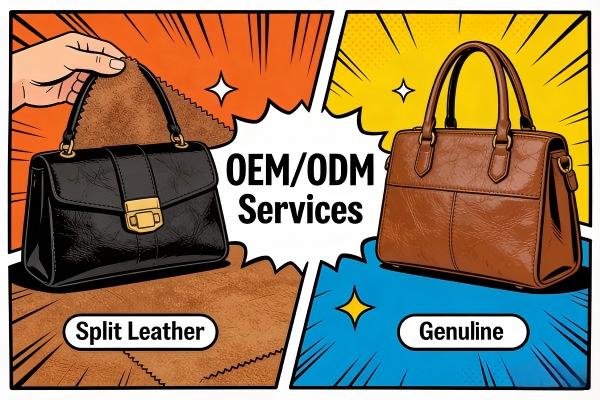
Here are Junhao’s core production solutions sorted into a table. You can clearly see the advantages and applicable scenarios of each solution:
4.1 Core Production Solutions for Brands
| Solution | Key Advantage | Target Use Case |
|---|---|---|
| Low MOQ (100pcs) | Test trend-driven designs low-risk | Seasonal split leather3 lines |
| Customization | Premium finishes/colors/craftsmanship | Differentiate mid-tier/premium lines |
| Transparent QC | 3-round tests + certification | Build consumer trust |
| Cost Optimization | 15–20% cost cut via direct sourcing | Mid-tier $80–$150 price point |
My friend’s brand has grown a lot since partnering with Junhao. Let me tell you about her experience. First, the low MOQ of 100 pieces was a game-changer for her. She wanted to launch a seasonal split leather3 line with pastel colors. She was worried about overstock. Junhao’s low MOQ let her test the market with small investments. The line sold out quickly. She then scaled up production to 5,000 pieces. Second, Junhao’s customization options helped her differentiate her brand. She chose premium polyurethane coatings for her split leather3 bags. The coating mimics the look of top-grain leather4. She also added custom embossing with her brand logo. These details made her bags stand out in the market. Third, Junhao’s transparent QC process built her customers’ trust. Junhao provides 3-round tests: material testing, in-line checks, and post-production durability tests. They also offer leather grade certification. My friend’s customers feel confident buying her bags because they know the leather quality6 is guaranteed. Fourth, Junhao’s cost optimization helped her set a competitive price. Junhao sources hides directly, cutting 15–20% of the cost. My friend’s split leather3 bags are priced at $80–$150. She maintains a 45% profit margin. Junhao also supports a hybrid strategy. My friend now has a core line of split leather3 bags and a limited-edition line of top-grain leather4 bags. This strategy balances high-volume sales and brand elevation. She is very satisfied with Junhao’s services.
5. When to Choose Split vs Genuine Leather for 2026 Handbag Lines?
After understanding Junhao’s production solutions, brand owners may still wonder when to choose split leather3 and when to choose genuine leather1 (top-grain) for their 2026 lines. Many brand owners I know are unsure which leather fits their audience. They worry about overstock. I have studied the 2026 market. I found that the choice depends on your target audience and product positioning. A hybrid strategy can boost growth for most brands.
You should choose split leather3 if you target 25–35-year-old budget-conscious shoppers or launch trend-driven designs. You should choose top-grain leather4 if you target 35–55-year-old luxury buyers or timeless styles. A hybrid strategy (split core + top-grain limited-edition) works well for many brands.
I have sorted the target audience and applicable designs of the two leather types into a table for your reference:
5.1 Target Audience & Use Case Match
| Leather Type | Target Audience | Ideal Designs | Key Benefit |
|---|---|---|---|
| Split Leather | 25–35yr budget-conscious shoppers | Casual crossbodies/totes | Cost-effective, scalable |
| Top-Grain Leather | 35–55yr luxury buyers | Structured satchels/timeless totes | Durability, patina appeal |
I have talked to many brand owners. Their experiences confirm that the right leather choice is crucial for success. Let’s start with split leather3. If your target audience is 25–35-year-old budget-conscious shoppers, split leather3 is a good choice. These shoppers want real leather but don’t want to spend too much. They like casual styles, such as crossbodies and totes. Split leather is cost-effective and scalable. A brand owner I know targets this group. She uses split leather3 for her casual tote bags. She sells 10,000+ pieces every season. Now, top-grain leather4. If you target 35–55-year-old luxury buyers, top-grain leather4 is better. These buyers value durability and quality. They prefer timeless designs, such as structured satchels. Top-grain leather’s durability and patina appeal match their needs. A luxury brand I follow uses top-grain leather4 for its classic satchels. These bags are priced at $200+. They have a loyal customer base. A hybrid strategy is also a great option. Many successful brands use split leather for their core lines. They use top-grain leather for limited-edition lines. This strategy leverages high-volume sales from split leather. It also elevates the brand’s image with top-grain leather. Junhao supports this strategy well. They offer seamless production across both leather grades. Brands can keep consistent branding, such as matching hardware and logo embossing. My friend’s brand uses this hybrid strategy. Her core split leather line drives sales. Her limited-edition top-grain line attracts high-end customers. Her brand has grown steadily.
Conclusion
For a related production-service reference, review custom leather bag manufacturing; confirm the current scope, quotation, sample plan, quality requirements, and contractual terms for the specific project.
In 2026, choosing between split and genuine leather depends on your budget, usage, and audience. This guide provides practical tips for shoppers and brands. I hope it helps you make smart decisions.
Understanding the true meaning of 'genuine leather' can help you make informed purchasing decisions. ↩
Discover the truth about bonded leather to avoid low-quality purchases. ↩
Learn about split leather to choose budget-friendly yet quality leather options for your handbags. ↩
Explore the benefits of top-grain leather for long-lasting and durable handbags. ↩
Get tips on selecting the right leather handbag for your style and budget. ↩
Understanding leather quality will help you select the best products for your needs. ↩
